

The sad truth is that most evil is done by people who never make up their minds
to be good or evil. -Hannah Arendt
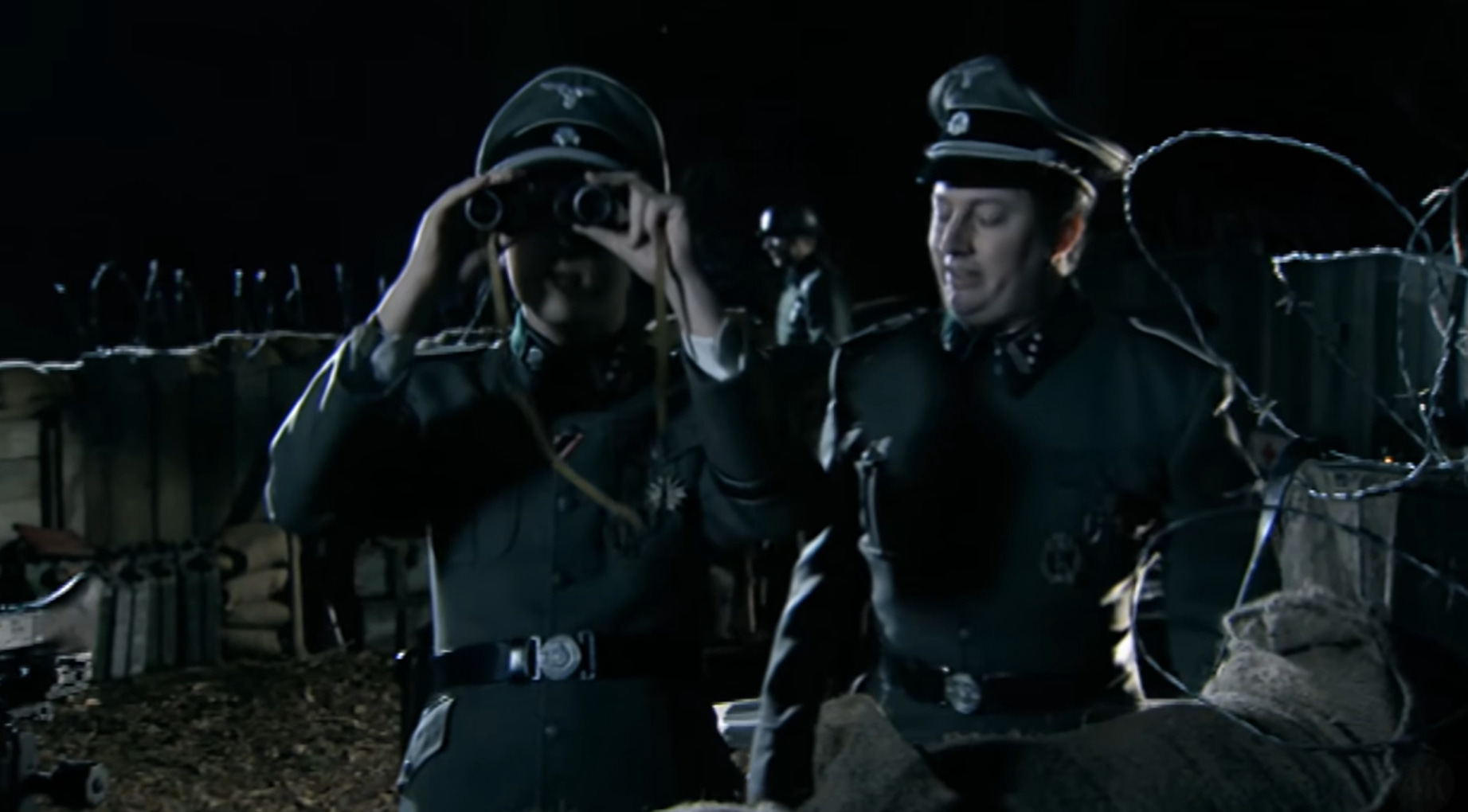
There’s a British comedy sketch where two Nazi officers are sitting around during the war, bored, making small talk. One of them starts to feel a vague discomfort. Not guilt, exactly. More like the feeling you get when you realize you’ve been sitting on your foot too long and it’s gone numb in a way that feels vaguely ominous.
He looks down at his uniform.
There’s a skull on it.
Not a metaphorical skull. Not a poetic skull. A literal skull. With teeth. Like something you’d find on a pirate flag or a poison bottle or the label of a particularly aggressive household cleaner.
He asks, tentatively, as if the question itself might be treason:
“Are… are we the baddies?”
His friend is offended. Of course they’re not the baddies. They have rules. They have order. They have an ideology. They’re very organized. But then he looks down at his own uniform. Skull. Looks around the room. More skulls. On the hats. On the flags. An entire aesthetic commitment to death.
The realization isn’t explosive. It’s administrative. Slow. Embarrassing. Like discovering you’ve been pronouncing a word wrong for years, only the word is evil.
The joke works because the skulls have been there the whole time.
I laughed the first time I saw it. A real laugh. Then there was a second laugh underneath, colder and quieter, the kind that doesn’t feel very proud of itself.
Because the question isn’t really about Nazis.
It’s about how rarely we ask the question at all.
Hannah Arendt saw this up close when she attended the Nazi trials. What unsettled her wasn’t monstrous rage or theatrical cruelty. It was how ordinary it all was. The men she watched weren’t cackling villains. They were bureaucrats. Dutiful. Mild. People who went home at night and believed they were decent.
She called it the banality of evil.
Not because evil is trivial, but because it so often looks unremarkable once the uniform comes off.

Whenever we watch a movie, read a novel, or hear a parable, it’s striking how easily we know where we stand. We are never the villain. Never the crowd. Never the ones doing harm in good conscience. Even when the story is about repentance, we read it as aspiration instead of diagnosis. Stories are generous that way. They angle the mirror just enough that we mostly see our good side.
But what if the point of the story isn’t to help us identify with the righteous character at all?
When the unease finally creeps in, when something doesn’t quite sit right, there’s a familiar fork in the road.
You can pledge loyalty.
You can explain that it’s more complicated than it looks. That the rules are necessary. That the alternatives would be worse. That you’re just doing your job, just following procedure, just keeping things from falling apart.
Or you can have the much quieter realization that maybe the emperor doesn’t need new clothes.
Maybe the problem isn’t that you’ve misunderstood the uniform.
Maybe the problem is that you’ve been wearing it so long it feels like skin.

I think about how this happens not only in stories, but in real institutions. Real agencies. Real rooms where badges clang softly against desks and the language keeps getting cleaner while the consequences get messier. Places where dignity doesn’t disappear all at once, but leaks out slowly, almost politely.
Meister Eckhart believed that awakening doesn’t begin with moral improvement, but with seeing. With a loosening of our defenses. A willingness to release the stories we use to protect ourselves from what’s already true.
For him, illumination wasn’t about becoming better. It was about becoming less certain. Less armored. Less invested in proving we’re on the right side.
Recognition, when it comes, is often grace before it is change.
The danger is not that we resist transformation.
The danger is that we refuse recognition long enough that we stop being surprised by the harm we cause.
I’m starting to think this is why we avoid so many forms of noticing.
We don’t step on the scale.
We don’t check our blood pressure.
We don’t look too closely at the quiet distance growing in a marriage.
But not all hard truths are accusations.
A marriage falling apart doesn’t mean the people in it are bad.
It means something precious is hurting.
Some realities don’t ask for punishment.
They ask for grief.
Bodies don’t wait for our readiness. Relationships don’t either. And neither does the harm we cause when we don’t want to know we’re causing it.
The tragedy isn’t that we’re flawed.
The tragedy is that we’ve been taught to confuse awareness with damnation.
Thomas Merton warned that much of what we call goodness is really the careful maintenance of a false self. A self that knows how to behave, how to belong, how to avoid embarrassment. A self that is very invested in not being the problem.
The false self loves uniforms.
It loves approval.
It loves being certain it’s not the baddie.
And if I’m honest, the hardest place this shows up for me isn’t institutions or ideologies.
It’s my daughter.
There are mornings when I can tell almost immediately that I’ve done something wrong. I don’t know what it is. That’s part of the problem. But she knows. The evidence is everywhere. Short answers. No eye contact. A silence that feels intentional, almost architectural.
I try to reconstruct the crime. Was it my tone? A joke? A look? Some casual dismissal I didn’t even feel myself making?
By evening, more often than not, she’s fine. Laughing loudly. Sitting close. Asking for money with a confidence that suggests complete emotional recovery.
Which should reassure me.
And does.
Mostly.
But a question lingers underneath the relief.
Do I ever actually learn?
Or do I just wait it out?
Do I notice the skulls? Or do I tell myself this is just how mornings are?
I want to believe I’m not malicious. I want to believe I mean well. I want to believe my intentions should count for something. But intention doesn’t erase impact. And love doesn’t automatically make me safe.
I don’t think I’m addicted to being great.
But I am deeply invested in being good.
Or at least in not being the baddie.
And why wouldn’t I be?
We treat baddies terribly.
We don’t just say they’ve done bad things. We say they are bad. Completely. Permanently. We strip them of complexity and dignity until they stop feeling human at all. They become monsters. Warnings. Shapes we point at so we know where not to stand.
Which makes becoming one of them unthinkable.
And if it’s unthinkable, it’s also unnoticeable. Because if baddies aren’t human, and I am human, then I can’t be one. Not really.
I’m starting to think we’ve handed this story over to shame, the kind that makes us flinch before we’ve finished noticing, reaching first for a villain instead of tending the wound.
But this feels more like a story about humanity.
About learning to notice when I’ve become dangerous without turning myself into a monster. About allowing that holy glimpse of recognition to do its work. About staying with the discomfort long enough for wisdom to grow.
I’m not asking us to decide once and for all who the baddies are.
I’m asking whether we’re willing to notice when we might be becoming them.
Maybe the point isn’t to stop being capable of harm. That feels unrealistic. Possibly inhuman.
Maybe the point is to become just conscious enough of my own wickedness to interrupt it. To apologize without self-defense. To change without theatrics. To offer dignity even while condemning harm.
To love myself regardless of innocence, and still take responsibility.
Because if dignity is only available to the people who never get it wrong, then it was never dignity to begin with.
It was just another uniform.
Parenting...a beautifully meaningful substantive inconvenience that I would never trade. Also, I absolutely love this substack.