

“We know Him in the breaking of bread.” -Dorothy Day
I am, if I’m honest, a compulsive eater. It’s how I soothe. I don’t mean I love good food. I mean there are nights I stand at the sink long after I’m full, eating anyway. Not because I’m hungry. Because something in me wants quiet.
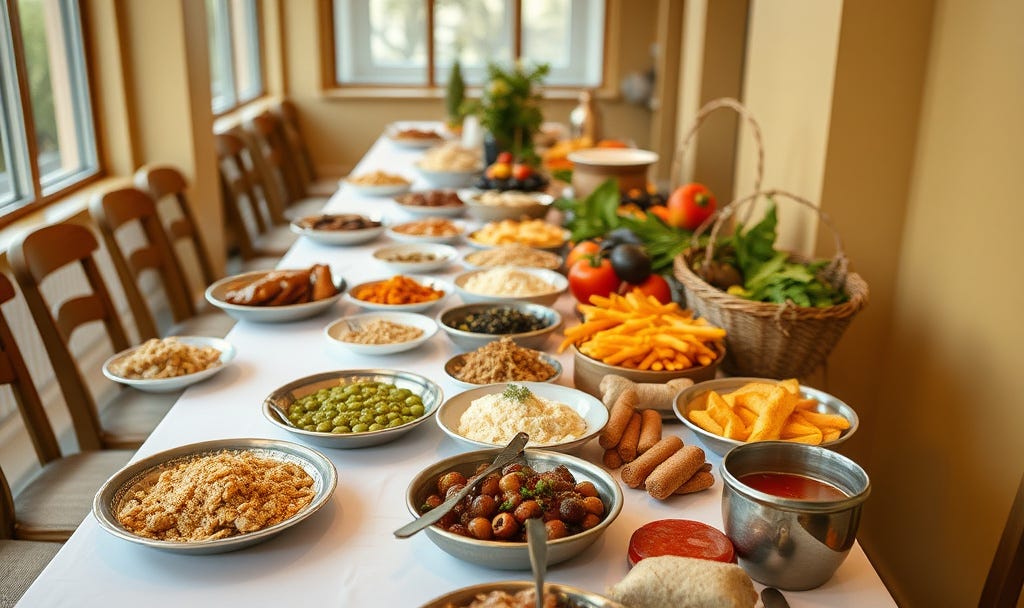
Nothing feels quite like my mother’s kitchen. The smell of her cooking would move through the house and pull me from my room the way cartoons show pies lifting a character into the air.
Garlic warming in oil.
Onions and peppers softening in the pan.
Rice steaming the way only she makes it, each grain separate and soft.
Plantains sizzling at the edge of the stove.
I was not deciding to come to the table.
I was being gathered.
I think I am still looking for that.
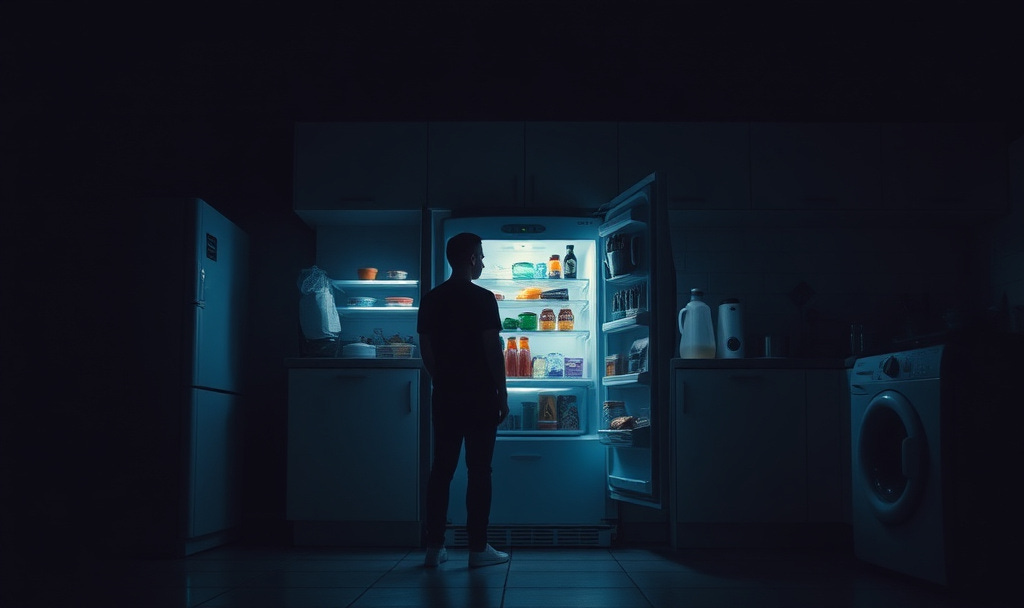
Sometimes, late at night, I open the refrigerator and stare. I am not looking for calories. I am looking for relief, for warmth, for a place to rest inside myself. The food works for a moment. Then it does not. So I try again. The body fills. The ache remains.
It took me a long time to realize I was not actually hungry.
I was homesick.
This week I met with a dietitian for the first time. He asked me to log everything I eat. Everything. The instruction sounded simple until I started doing it. Within a day I discovered something embarrassing. I graze constantly. A handful of chips here. A cookie there. Something sweet while walking through the kitchen.
I told him I felt like a junk food raccoon wandering the house and grabbing whatever shiny snack appears.
What surprised me most was not the amount of junk but what happened when I started paying attention. When I actually write down what I eat, something changes. I begin to notice how certain foods leave me sluggish. Others settle me. The body responds differently when I stop grazing and sit down for a meal.
Attention itself begins to change the appetite.
Hunger behaves differently when it is seen.
The experience has made me suspicious of how casually I consume other things too. You start to notice what actually nourishes you and what simply keeps you grazing.
Sometimes we approach God the way a tired person approaches a refrigerator at midnight.
Hoping that something inside will finally satisfy the ache.
I used to think the opposite of hunger was fullness. I do not anymore. The opposite of hunger is not eating. It is forgetting what food is for.
My father used to say, “For the hungry, there is no stale bread.” He never meant that poetically. He meant it literally. When you have known real need, you do not negotiate with nourishment. You receive it.
Many of us are not starving for meaning. We are surrounded by it and still unsatisfied. We sample endlessly and digest little.
In Buddhist imagination there are beings called hungry ghosts. They have enormous bellies and impossibly tiny mouths. They wander constantly trying to consume, but whatever they swallow turns to ash.
They are not punished. They are trapped in a relationship to desire that makes satisfaction impossible.
There is a form of spirituality like this. Always seeking a truer teacher, a deeper practice, a purer community, yet never nourished because ordinary food does not count as food. Daily prayer feels insufficient. Community feels disappointing. Service feels mundane.
Only intensity feels real.
Spirituality becomes a tasting menu of transcendence. Beautiful. Refined.
Still hungry.
The stomach grows.
The mouth shrinks.
An older story tells of a people in the desert receiving daily bread, enough for the day. Before long they grow tired of it. They want something stronger, something richer, something dramatic. They demand meat.
It is a strange thing to grow tired of bread.
Bread is slow. Ecstasy is immediate. A life trained on stimulation forgets how to recognize sustenance.
Taoist writers once mocked what they called a “fat country,” a people so comfortable they became abstract. They admire wisdom but cannot endure inconvenience. They speak easily about harmony but grow impatient when life asks them to chop wood, carry water, or wait.
Spirituality can drift into this condition. It explains suffering instead of accompanying it. It analyzes love instead of practicing it. It interprets existence instead of participating in it.
When spirituality never gathers wood or prepares a meal, it slowly loses contact with the earth.
It becomes tourism of the sacred.
But there is another reaction as well.
Some people were not overfed. They were malnourished. They were raised on spiritual empty calories. Certainty without humility. Belonging without honesty. Emotion without formation. The sugar rush of camps, altar calls, and immediate answers, but no practices for grief, doubt, patience, or adulthood.
So they stopped eating.
They deconstructed, which was often necessary. Sometimes the only faithful response to bad food is to stop eating it.
But leaving the table is only the first movement of hunger. Eventually the body still asks to be fed.
They left the table but never found another meal.
Some people binge spirituality.
Some people fast to avoid being poisoned again.
Both remain hungry.
Sometimes this hunger takes a darker form. You can hear it in the strange spiritual appetite for catastrophe. There are always voices insisting that war must come, that violence must escalate, that history needs blood in order for prophecy to be fulfilled.
The destruction itself becomes a kind of spiritual spectacle.
It is another form of junk food.
It tries to dress cruelty in the language of hope.
If spirituality cannot teach us how to remain human in the face of suffering, what exactly is it feeding?
Even if the world were ending tomorrow, it is hard to see how that would lessen our obligation to love one another. If anything, it would intensify it.
I am becoming suspicious of spiritualities that cannot survive ordinary life.
Some float above the world in mystical language. Others live in permanent reaction against the past. One lives on ecstasy. The other lives on negation.
Both share the same assumption.
Real life cannot nourish the soul.
Yet the traditions keep pointing somewhere much less dramatic. Shared meals. Daily prayer. Forgiveness. Work. Care for neighbors. Patience. Grief.
Bread.
A spirituality that avoids bodies and responsibilities becomes escapism. A spirituality defined only by rejection becomes fasting without purpose.
Neither feeds a human life.
What if spirituality is not meant to carry us out of life but to teach us how to receive it?
Not constant insight.
Not constant intensity.
Capacity.
The patience to love imperfect people. The courage to endure ordinary days. The willingness to remain present when life is inconvenient, boring, or painful.
A true spirituality must be edible.
It must touch bone and earth.
My father was right.
For the hungry, there is no stale bread.
The spiritually mature person is not the one who has tasted everything, nor the one who rejects everything.
It is the one who has relearned how to receive nourishment.
Someone who can live an ordinary Tuesday and discover that life itself has begun, quietly, to feed them.
The goal of spirituality is not transcendence.
It is not deconstruction.
It is learning, slowly, how to leave the refrigerator closed
and sit down at the table.
The place where food is shared.
Where someone is cooking.
Where the house begins to smell like garlic and rice again.
The place where hunger is not managed
but welcomed
and fed.
peace.
About the author: Daniel Gutierrez, Ph.D., LPC, CSAC, is a Contemplative Existential Psychotherapist, Mental Health Researcher, Professor & compulsive eater.
Thank you Daniel, this one has sustenance.