

“We are all meant to be mothers of God, for God is always needing to be born.”
— Meister Eckhart
The Car Line Incantations
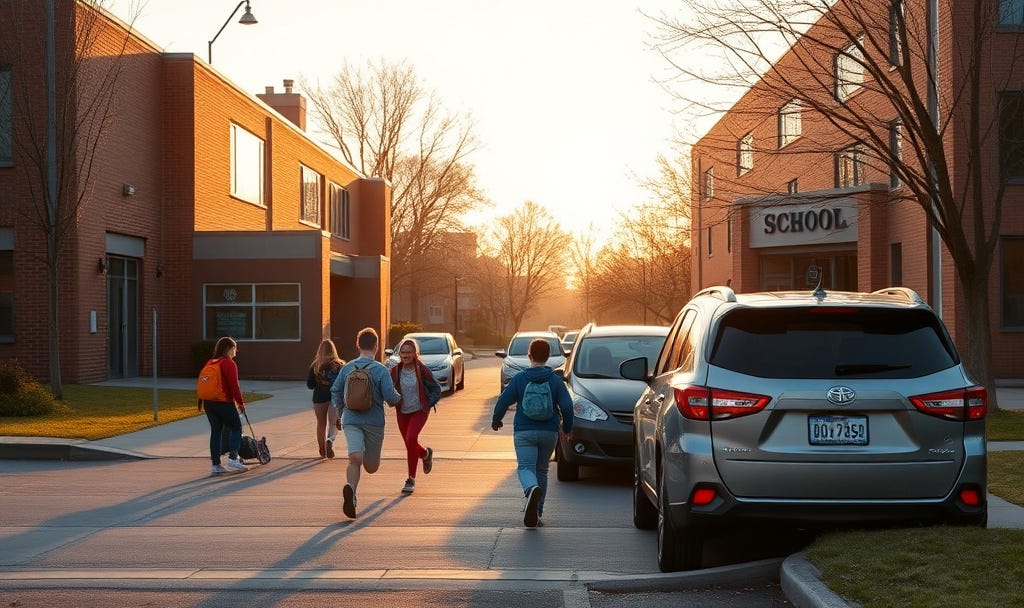
I am a parent of two teens, which means that most mornings I get to experience the middle school car line.
From a distance, the car line looks like a well-oiled machine. Cars inch forward like oversized metal gears, turning slowly and methodically, part of some elaborate child-producing apparatus. When the line pauses, doors pop open in near unison. Kids tumble out. Underpaid administrators point and whistle, herding them toward the building with the weary authority of people who have already had this same conversation six hundred times.
From the inside, the experience is different.
Inside the car, the kids grip their seat belts like paratroopers storming a final battlefield. You strap backpacks onto their shoulders and do everything you can to eject them from the vehicle with everything they might need before you pass the drop zone. You grip the steering wheel and steal a glance at the rearview mirror, terrified of being that parent, the one who holds the whole line up because they cannot find a mitten or a permission slip in time.
The radio plays your morning music, but it all sounds muffled, like it is coming from underwater, as you run through the checklist. Lunch box. Water bottle. Homework you signed but did not read. You reach for the thermos they forgot to close. It spills onto your coffee cup. The heater wheezes. The door clangs open.
And then, just before they step out, you catch a glimpse of your child’s face.
Like a military officer tossing a grenade ahead to clear the way for a much smaller soldier, you mutter something stupid.
Make good choices.
As if they were not already planning on that. As if, in that moment, you had somehow foiled their master plan to make terrible ones. Bad choices. Memorable choices. As if they even knew what you meant. As if that sentence could land in any teenage register beyond an eye roll and a limp shrug that says, sure, whatever helps you sleep.
Oh, I have had a lot of these gems over the years.
Be the change. What parent doesn’t quote Ghandi at a child?
Fly your way, not theirs. Still my personal favorite, shamelessly stolen from The Wild Robot. It is a sentence that sounded wise until I heard myself say it out loud and realized it was slightly wrong. Because I did want them to fly with the group sometimes. Especially on field trips. And definitely in science class.
As they got older, and I slowly accepted how useless all of this was, the sayings got stranger. More specific. More honest.
Don’t eat off the floor.
Don’t bring a raccoon home.
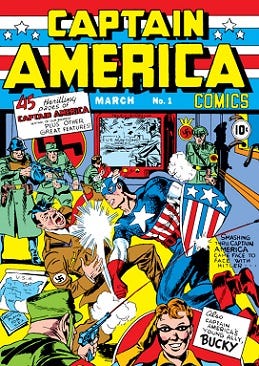
Don’t punch anyone. Well, unless they are a Nazi.
Even Captain America punched Nazis.
We toss these lines like charms. Half joke. Half prayer. A rattling little necklace of sayings we hope might wrap around our kids as they step into the day. They sound foolish even as we say them. Our kids roll their eyes or pretend they did not hear.
Existential scholars suggest that when we are confronted with uncertainty we cannot control, we reach for meaning instead. Not because it fixes anything, but because it lets us stay present without going numb. These little phrases are not instructions. They are acts of resistance against the scary unknown. Not because silence is dangerous, or mystery is something to be solved, but because fear thrives when we let it mute our voices.
And maybe none of it matters. Maybe none of it sticks.
Or maybe, we can hope that years from now, they will remember the way our voices wobbled with a kind of desperate love for them.
Words From Heaven?
As I read the Advent story in Luke, I keep noticing how often words are given to people who probably do not fully understand them. Not because they are confused or unfaithful, but because love can be clear long before its consequences are.
Shepherds.
Mary.
Joseph.
All of them receive sentences heavy with promise and fear, spoken out of desperate love. They knew something holy was being asked of them. They just could not have known the shape it would take.
The shepherds did not expect a manger.
Mary could not have imagined that the child she was teaching to walk would one day be nailed to a cross and somehow live again. That she would name him, and that name would be spoken in beautiful ways and also used to justify terrible things.
Their journey was not a car line. It was the fleeing of state-sponsored violence. It was moving from place to place, knocking on doors, looking for somewhere, anywhere, that might say yes. Instead, the incantation they kept hearing was no, as in, there is no room for you here.
Not the spell of protection we try to place on our kids when we push them out into the world. This was a spell of limitation.
There is no room for you who are in need.
There is no room for you who are most vulnerable.
The heavens sing for you, but I have no room for you.
One of the mystics said that God is always coming to us disguised as our own lives. Which makes me wonder what we do when our lives arrive inconvenient, crying, undocumented, and in need of shelter.

Words That Make Room?
Meister Eckhart warned that if Christ is not born again in us now, then his first birth does not save us from much. I hear that and wonder, if he were born today, would there be any room. If the heavens sang again about a miraculous new life, would we stop long enough to listen, or would we shrug and say we are full.
If life calls us to more, can we make space?
I think I know the answer to that.
I see it in the news.
I see it in the way we talk.
We can.
I am just not sure we would.
I picture Mary and Joseph walking across the desert with their newborn, nothing but starlight, sand, and the pounding fear of not knowing where they will sleep. Every door answering their knock with the same cold phrase. No room here.
What do you say to a child when the world keeps saying that. What kind of sentence can hold hope together when every inn is already full.
Psychologists who study human fear say there are a few fundamental terrors we all share. Death. Isolation. Freedom. The threat that none of this means anything at all. Standing at a closed door with a child in your arms manages to gather all of them at once.
And then my mind jumps to the border. An immigrant mother clutching her toddler, rehearsing whatever threadbare blessings she can muster. Or a documented family, perfectly legal, still bracing under the weight of suspicion, sirens, paperwork, and the low, constant hum of state-sponsored fear.
Words of Hope?
What good are our little incantations then.
Maybe not much.
Maybe everything.
Maybe hope is always spoken in situations where it looks useless. Hope does not eliminate the unknown. It just refuses to let fear have the last word.
Maybe every parent, ancient, exhausted, holy, terrified, has whispered some version of this. I know the world says there is no room for you, but I am making a room anyway. I am making room with my breath. With my voice. With whatever scraps I can carry.
The car line rolls forward. Another morning. Another small human stepping into the cold, tugging their backpack up like a shield. I roll down the window and offer my silly benediction, my cracked little charm.
It is not much.
But it is the best spell I know.
Please consider supporting this work by liking, subscribing, and sharing.
“Have fun storming the castle!” has come out of my mouth more times than I could count, and now continues with grandchildren, for there are still walls to assail.
Beautiful.. I couldn't help but remember being in a car line at a private school in Orlando we couldn't afford with cars that were newer, brighter and ten times as expensive as our rusty Dodge spewing trash as the kids piled out. . Emblematic? There's certainly deeper spiritual truths there too I suppose.