

“Anxiety is the dizziness of freedom.”
— Søren Kierkegaard, The Concept of Anxiety
Stop me if you’ve heard this one….
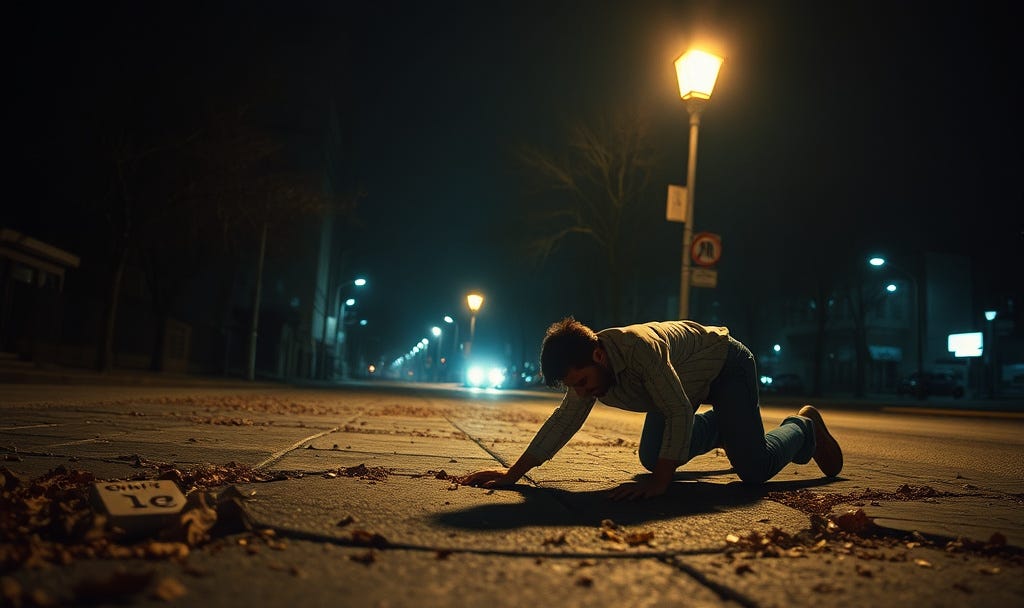
Nasrudin is searching for his keys beneath a streetlamp. He’s bent over and stumbling around on his hands and knees trying desperately not to dirty himself as he leaves no stone unturned.
A kind neighbor stops to help. He takes off his jacket and crawls around too. Befuddled, the neighbor asks:
“Are you sure you lost it here?”
“No,” Nasrudin replies. “I lost it somewhere inside my house.”
“Then why are you looking out here?”
“Because the light is better.”
I know, it sounds a bit like a medieval dad joke, but stay with me. You might recognize the name Nasrudin (sometimes Nasreddin) as the main character of many folklore stories in the Muslim world. Known for offering insights through satire, Nasrudin sheds light on our wise foolishness or maybe just our foolishness.
What you see is what you get.
And, the Wise Fool, as he is often known, is pointing to something simple but profound here. Like moths to a flame, we search where the light is.
We fly towards what is illuminated. We look toward whatever everyone else is examining, and because we can see it clearly, we assume what we see must be where the answer is. And, how can you blame us? The world we live in works very hard to take captive our attention, and it’s easy to be distracted by the pretty lights.
Countless nights, I find myself scrolling mindlessly when I know I need to sleep. I count the hours till morning, but the algorithm, that invisible force that sits behind my computer screen keeps feeding me an endless feed of provocative lists of nature sights, top restaurants, and life hacks. It doesn’t care what time it is or if I have work in a few hours, it’s making a list of content just “for me.” How can I dare fall asleep if I haven’t finished watching this video of a monkey opening a package?
Ok, but it’s as much the algorithm’s fault as it is the monkey’s. The algorithm did not invent this problem. It simply purchased the streetlamp. It happens all the time.
When you buy a new car and suddenly every time you get on the highway you start to see your car every where. You just learned that new word from the New York Times crossword puzzle and hear it three times before dinner. And, once you find Waldo, you can never lose him again. He can never return to the anonymity of the crowd.
Your eyes are drawn to the light under the streetlamp. Your vision is locked in, and your world is limited to that tiny space between the shadows.
Enter the Cyclops.
Polyphemus (the Cyclops in The Odyssey) can teach us something more about what it means to see. His one enormous eye allowed him to see everything that stood directly in front of him. He could count his sheep, take note of an intruder, and explore his cave. He had sight, but what he was missing was depth.
One of the blessings of modern life is our ability to see into the farthest reaches of the known world. We see what is in front of us, but we only see where the light is good. The algorithm keeps our vision shallow. It logs what we click, crave, desire, and fear. It feeds back a picture of a world we want to see illuminating only fragments of reality. We are left with a fragmented view of life.
Fr. Richard Rohr has said, “How you see anything is how you will see everything.”
With just one eye we see the world flatly. We don’t get perspective. We lose dimension. We believe only the pretty lights. We become prisoners of a dark cave, judging the world only by the shadows cast from the fire.
When you spend too much time seeing the world through one eye it becomes difficult to imagine life looking any other way.
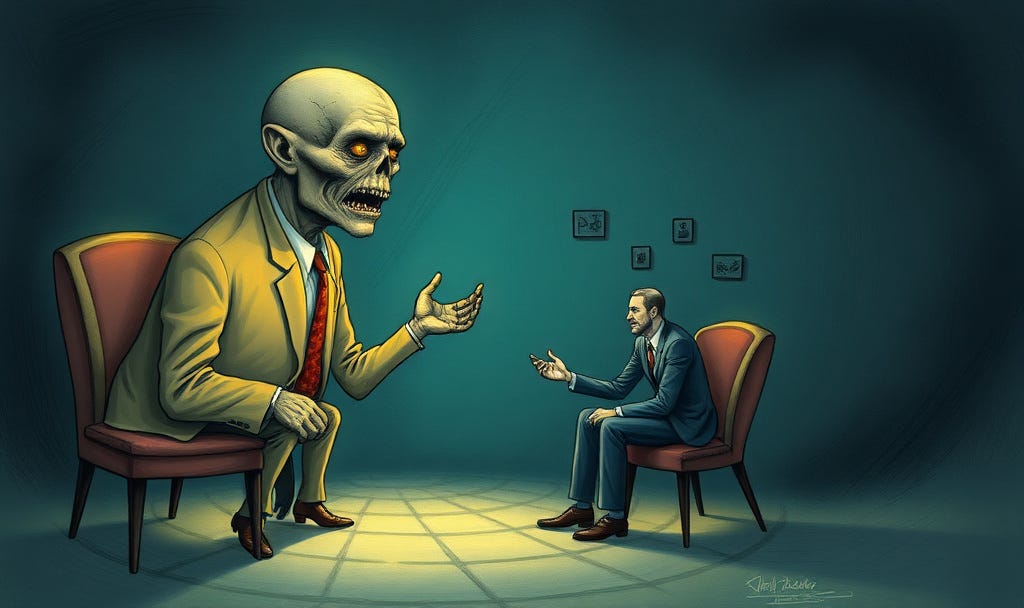
As a counselor, I’ve heard the Cyclops story many times.
I’ve listened to stories of people who have stayed at the same job for decades because they cannot imagine themselves doing anything else. Like ants marching from the subway to work each morning, they do it the same way, every day. They tolerate life rather than live it, staying tired and weary, and too scared to make the change.
Others do a similar dance at home. They sit in silence as their marriage continues to grow cold. They cannot imagine surviving the necessary conversation. They can’t imagine taking the next steps regardless of how depressed they feel.
And of course, there are so many of us who have this inner critic that pokes at our eye whenever we try to open it. The inner critic is in service of an inner algorithm that serves you nothing but toxic videos from childhood, horrible sermons, and bad lessons, all designed to make you feel worthless, hopeless, and not good enough. You end up organizing your life around expectations and rules that deny your dignity, self-worth, and authenticity. You have long known that you no longer need to follow those rules but you keep anticipating disappointment, punishment or being abandoned. You end up feeling trapped.
And surprisingly, you become fiercely protective of this flat way of seeing. It’s flat. It’s fake. But it’s familiar. Unfortunately, our clinging to this familiarity not only limits our flourishing, it leads us to despair.
When we flatten our view of what is possible, we flatten our hope for the future. Tomorrow starts to feel less like a horizon full of illumined possibilities and more like a candle whose wick is about to go out.
The tragedy of the Cyclops is not that he cannot see. It is that whatever he sees arrives without enough depth, and there is a certain level of despair that comes from certainty without dimension.
A life of depth deprivation can be dangerous. We can become so accustomed to our one-sided view of our flat world that we fear another perspective might knock us over the edge or worse it might invite us to something new.
But, I wonder, isn’t that what some of us want?
Yes, it might mean leaving, or staying and finally speaking, or disappointing someone else or maybe even discovering that the voice inside our heads, the one we obeyed for our whole lives wasn’t our own, but some faith leader or parent who got it all wrong. But, isn’t it possible that all of that might be better than staying where we are?
I know, it’s scary to turn away from the algorithm. It’s terrifying to find a new way of seeing. It will take courage and terrifying choices. But, would it be worth it, to see the world for what it really is?
Kierkegaard famously stated that anxiety was “the dizziness of freedom.” When you stand before all the possibilities and all the choices, and you realize there is so much uncertainty and mystery, there is certainly something unsettling about that. Dizziness is the perfect term, because when we are truly embracing our freedom, and we are going to have to confront many of the things that constrained us, like our history, circumstances, wounds, responsibilities, and a thousand other things, and sift through all of that to find a choice.
I believe it was Irvin Yalom, Existential Therapist, who noted that the word “decide” is rooted in the phrase “to slay,” and it does feel like you are killing off one path when you choose another.
It’s often a lot easier to just pretend you have no choice and no responsibility. To accept the flat view of the world.
At this point, I could make this really political. I could say something about how we shouldn’t believe just one news source. How we should think more critically. How good science matters because it forces us to test our thinking. I could also make a call to action about how we should find ways of tricking our social media platforms to help us get more variety of news, wider range of information, to help us see more clearly.
But, I won’t. I won’t say all that. I’ll let you come to that conclusion on your own.
I’ll just turn back to poor Polyphemus.
In the Odyssey (no, I haven’t seen the Matt Damon one yet, I’m still looking for an IMAX with comfy chairs), Odysseus convinces the Cyclops that his name is Nobody. When Polyphemus is blinded, he cries out in pain and his fellow cyclops come running to ask who is attacking him, and Polyphemus responds:
Nobody.
Nobody is hurting me.
And they leave.
I know.. another ancient dad joke! Oh, Homer! What a comedian.
And, just like my earlier dad joke, this one also has a bit of insight in it.
Sometimes Nobody really is hurting us.
It’s not that your pain is imaginary or your wounds aren’t real or people don’t harm one another. We know that isn’t true. This world can be cold, dark and very lonely.
But sometimes, we are failing to see the whole picture.
That was then and this is now. We have more choices than we think.
Of course, the moment you start even imagining those courageous choices you might want to make. The moment you start to see and embrace the possibilities.
Your body begins to clench.
Your mind races.
Your tongue gets tied.
And, all you can do is think:
I can’t say that.
I can’t do that.
I can’t dare disappoint them.
I need to stay here, right here, under the flickering streetlamp. Alone.
This is part of what makes freedom so difficult. We aren’t just trying to escape the algorithms designed by Silicon Valley, we are trying to bypass the ones written on our psyches by people we’ve loved, institutions we trusted, people we feared, wounds we survived and all the places in us that we still need to forgive.
For some of this, the algorithm saved us. It helped us survive a complex dangerous world by simplifying it. However, it’s outlasted its purpose now. The danger has now passed.
You are safe now.
Nobody is hurting you.
And perhaps freedom begins there.
Not with deleting every algorithm. I’m not sure that is possible.
Maybe freedom begins when we can notice the voice telling us what we must see, and become curious enough to ask:
Is that still true?
Maybe we turn our heads.
Maybe we step outside the streetlamp.
Maybe we borrow another eye.
Maybe we discover the depth of the world.
And maybe, every once in a while, we hear the old warning inside us, look around the room, and realize with some astonishment:
Nobody is hurting us.
About the author: Daniel Gutierrez, Ph.D., LPC, CSAC, is a Contemplative Existential Psychotherapist, Mental Health Researcher, Professor & Trying to see with more than one eye.