

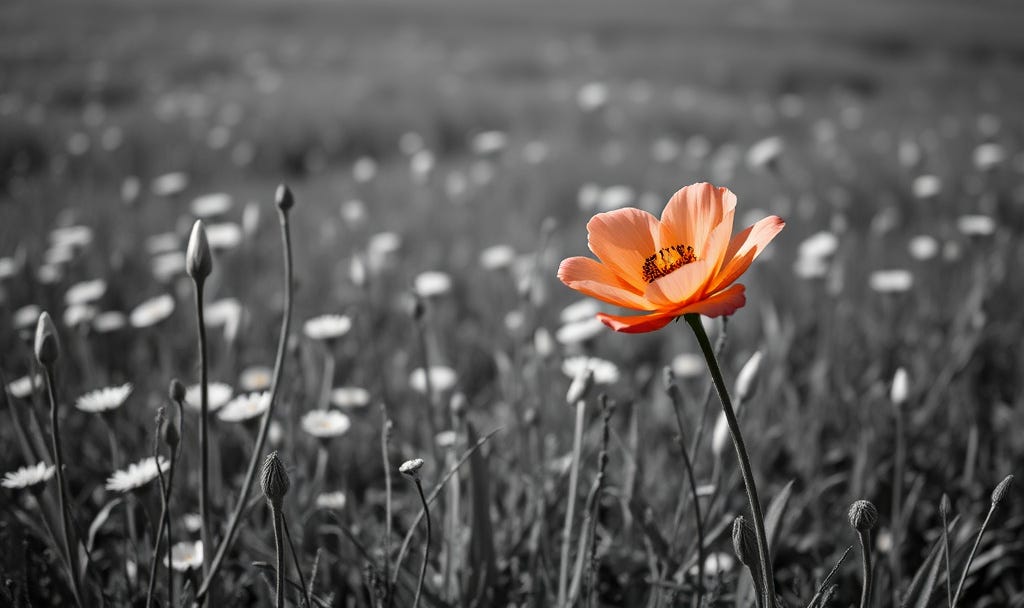
“What if instead of carrying a child, I’m supposed to carry grief?”
— Ada Limón, The Carrying
My friend
someone who feels as close to me as a sister
lost a pregnancy this week.
And even as I write that, I struggle.
Miscarriage.
I hate that word.
To mis-carry.
As if something was dropped.
As if she failed to hold on.
But she didn’t do anything wrong.
She did everything right.
She loved that child before there was much to see.
She spoke to it in the quiet language of mornings.
She sang to that child.
She talked to it.
She fell asleep with one hand resting on a future she could almost feel.
She woke up already rearranging the world to make space.
And still, in a way that refuses explanation,
the baby did not grow.
And now her life has split.
There is before.
And there is after.
Yesterday belongs to a different world.
A world where the future bent in a certain direction.
Where names hovered just out of reach.
Where ordinary moments carried a quiet electricity.
And now,
something else.
A new horizon.
Heidegger wrote that a horizon is where the unseen comes into view.
He said time itself is a horizon.
If that’s true, then grief is the moment the horizon moves.
The moment you realize you are standing in a different world
without ever having left the room.
Maybe this is what stories have always tried to name.
In the Marvel films, it’s a branching timeline.
A sudden split in the multiverse.
In Shakespeare, it’s Act Two.
The moment when what was foreshadowed finally arrives.
The shot rings out.
The audience goes quiet.
The play cannot go back.
Life, it turns out, has no interest in staying in Act One.
We all have these moments.
Fixed points.
Before this.
After this.
The day everything was one way
and then, without asking permission,
became another.
Maybe that’s what the garden was about.

The Garden of Eden
A story about a world that once held together.
And then didn’t.
A bite.
A realization.
A sudden knowledge of good and bad, loss and longing.
And almost immediately,
hiding.
Fig leaves stitched together in a hurry.
A quiet shame at being seen as we now are:
vulnerable, exposed, changed.
We leave the garden carrying something we didn’t have before.
And we don’t get to go back.
There’s a story from the Buddhist tradition.
A woman named Kisa Gotami loses her child.
She carries his body from house to house,
begging for medicine that might bring him back.
Someone finally sends her to the Buddha.
He tells her,
“I can help, but first, bring me a mustard seed
from a house that has never known death.”
So she goes.
Door to door.
And at every house, the same answer:
Yes, we have mustard seeds.
No, we have not been spared.
Every home carries its own quiet absence.
Every table has felt the missing chair.
She returns empty-handed.
Or maybe not empty.
She returns with the unbearable knowledge
that her grief is not hers alone.
That she has entered a world
where everyone is carrying something.
This is what happens, I think.
We cross a threshold we never would have chosen.
We lose something we cannot replace.
We become someone we didn’t plan to be.
And slowly,
sometimes reluctantly,
we begin to notice each other.
The way grief makes a kind of underground river between us.
The way suffering, for all its cruelty,
refuses to isolate us completely.
My friend is standing at that horizon now.
The world moves on around her.
Phones buzz.
Coffee is poured.
Conversations keep their easy rhythm.
It feels, somehow, like nothing has changed.
And yet everything has.
She has crossed over.
Into a world where this has happened.
Where this will always have happened.
And none of this makes it better.
None of it explains why.
But maybe, in time, it will make her less alone.
Maybe that is the quiet, stubborn hope.
Not that the world heals cleanly.
Not that the story makes sense.
But that we learn to carry what we cannot fix.
That we walk forward marked and tender.
That somewhere, in the middle of all this breaking,
we recognize each other.
And keep going.
Peace,
Daniel
About the author: Daniel Gutierrez, Ph.D., LPC, CSAC, is a Contemplative Existential Psychotherapist, Mental Health Researcher, Professor & Friend who wants to help carry.
Beautiful. Thank you.