

“Therefore flowers fall even though we love them;
weeds grow even though we dislike them.”
— Eihei Dōgen, Genjōkōan
(translated by Shōhaku Okumura)
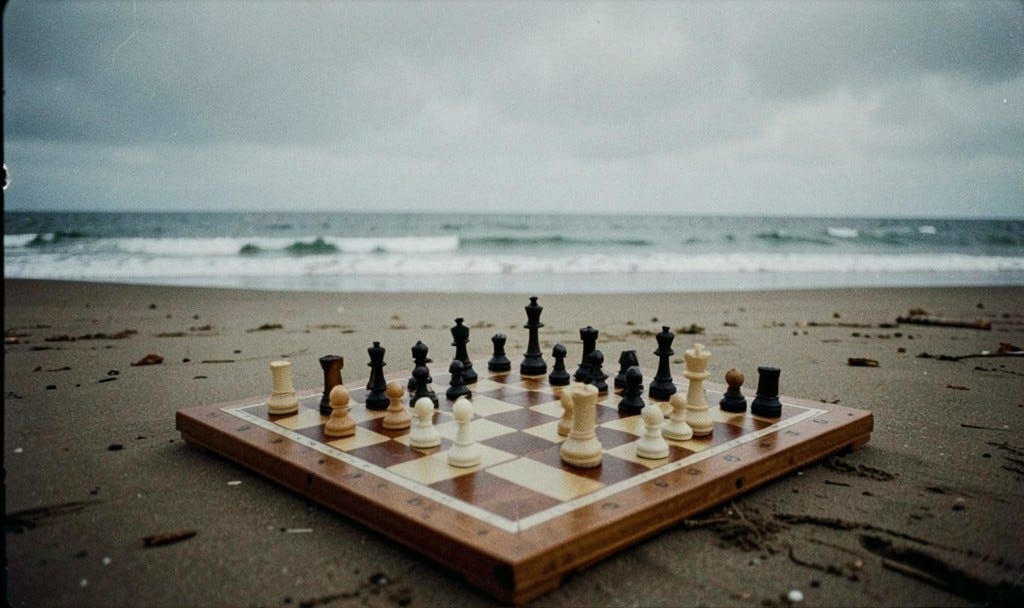
Have you ever seen Ingmar Bergman’s The Seventh Seal?
It’s about Antonius Block, a disillusioned knight who returns home from a crusade only to find Death waiting for him on a lonely beach.
The sea rolls and slams against the rocks.
The sky is gray, the beach desolate.
And there stands Block, gazing at Death’s ghostly pale face beneath a black cloak.
My favorite part is the way they look at each other on the beach. It’s hard to describe, but they enter into this intense mutual gaze that I can only compare to the feeling I get when I find out that Oreos are on a buy one get one free sale. It’s a rare kind of intimacy, breathtaking, and somehow an incredible value.
Death looks calm.
He’s not angry or cruel or in any hurry. You’d expect Death’s days are busy, but in this moment, he looks content to stand and gaze. He knows he is inevitable.
Block doesn’t look as afraid as I’d expect. Instead, he looks almost pensive. Perhaps, he is afraid, but he doesn’t show it in these first few moments. To me, he looks curious and defiant, maybe even a bit hopeful. He’s walked with Death before. They were like long-distance friends meeting for the first time.
When we have to look at hard things - the things that scare us - I think it matters how we look at them.
Trying to delay the inevitable, Block challenges Death to a game of chess. If he loses, Death takes him away, if he wins, he lives. In the meantime, Block buys himself enough time to ask Death the questions that were plaguing him and see if he can manage to find a way to commit “one meaningful deed.”
I remember watching this for the first time and thinking, I bet Death cheats at chess.
I was right. He totally cheats.
Although, for what it’s worth, I might assume Death cheats in the movies, but in real life, I can’t imagine anyone more honest.

In fact, I would say that throughout my life Death has been my greatest teacher. Hence, the name of this substack sounds like a law firm - Life, Death and Comedy, Attorneys at Law. These are my three favorite teachers. They have taught me more than any textbook.
And, with my mother’s health declining, death has been lecturing me like I’m in grad school again. I’m listening best I can, sitting in the front row, taking notes.
So, if you don’t mind, I’d like to take a moment to talk about death:
Throughout the years, we have given Death many faces.
Emily Dickinson described Death as a courteous gentleman. Death is portrayed in the Bible as the rider of a pale horse or the destroyer in the Exodus. And, who can forget the lovable, insecure, melodramatic grim reaper from the vintage classic - Bill and Ted’s Bogus Journey?
I imagine we give Death a face to manage our fear. Perhaps, it allows us to project some of our pain. It offers us a way of managing the sometimes ineffable ideas of loss and endings. Maybe we secretly hope we can find a way for Death to stare back at us, negotiate with us, be someone we can blame and argue.
Not unlike life, Death is full of mystery. Few have made it to the other side to tell us about it. We are left wondering and believing. We construct our mythos, our story, our framework to try and make sense of the mysterious non-sensical.
It’s easier to make Death a character rather than a part of life.
St. Francis of Assisi gave death a sibling’s face.
Near the end of his life, seriously ill and approaching death, St. Francis welcomed death itself as a sister: Sister Bodily Death.
He made Death family.
What was remarkable about what Francis did is that he didn’t just accept that death was inescapable; he acknowledged that she had a place in this world. She was a part of all creation. He gave her a seat at the family table and welcomed her.
Now, Francis saw Sister Death as the bridge to eternal life, and I can see being joyful about that. However, I think something else also happens when we welcome Sister Death. By reminding ourselves that we are on this Earth for a short time, and that nothing we have is ever ours to keep forever, we are suddenly pushed into a kind of urgency to love. Because loss happens. Things end. And fear is only a part of the story.
Everything has a beginning, a middle, and an end. My therapist taught me that. It’s a simple thought but that doesn’t make it any less true. We cannot fight that. It’s true. So, why run from it? Why try to battle and defeat it?
What would change for us if we started to understand that everything we love is infinitely fragile? If we accept that death is inevitable? Loss unpredictable? Life uncontrollable? What changes if we stop trying to defeat, own, protect, and cling to everything, and instead try and savor it while we have it?
I think answering these questions honestly is particularly difficult when we’re filled with the fear that we might lose something we love. We don’t typically like that. We often want love without the possibility of grief, connection without vulnerability, and success without the possibility of failure. We want the unreal.
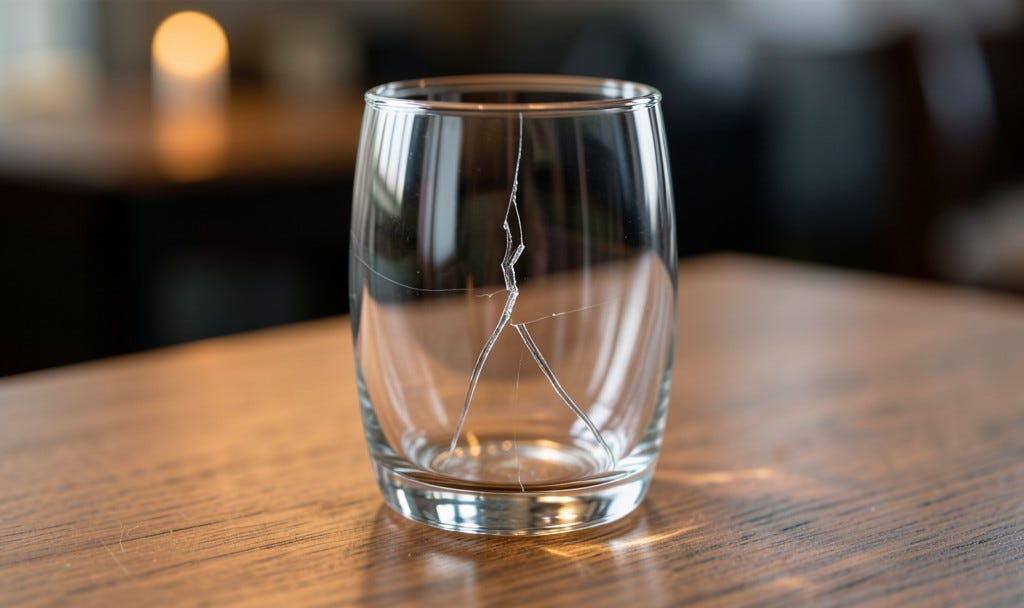
The Buddhist monk Ajahn Chah once held up a beautiful cup and said it was already broken. Now, the cup was just fine. It was a perfectly good cup. There wasn’t a crack or chip in it. Again, it was perfectly good.
But Ajahn Chah understood it differently. He knew that someday the cup might be dropped, or fall off a shelf, or maybe just get knocked over in the wash. Somehow, some way, the cup would break. So, to him the cup was already broken, and because he knew this, he could enjoy it all the more while it was in one piece.
What a deeply irritating idea! Beautiful, yes, but also… so annoying. Are we seriously saying that the best way to love a cup is to imagine its destruction? Can’t we just love the cup and not see it gone?
But he’s not wrong.
Everything we love is, in a sense, already broken and perfectly good. We know this in our soul. We know that nothing lasts forever, but still…our fear of loss interferes with our ability to savor. We keep the cup in the cabinet to avoid the chance it might break instead of drinking from it.
Which brings us back to the chess game and our disillusioned knight. Antonius Block was haunted by questions about God, suffering, and the meaning of existence. He uses the chess game to buy himself time. He feared that he might go to his death without gaining any of the answers to his questions, or worse, that he would die without the assurance that his life meant something.
That is, until something beautifully ordinary interrupts him.
As the story unfolds, we meet a small family of traveling performers: Jof, Mia, and their young son, Mikael. They end up sharing a simple meal of strawberries and milk with Block. It is such an absurdly ordinary moment in the film that it almost feels like a mistake. Up until this point, the film has been a meditation on the plague, violence, religious anguish, and the looming presence of death, and all of a sudden we are having a picnic.
I think the beauty of the scene is that it lasts just a few minutes, and still means everything for Block. The tenderness of this little family and their ability to enjoy life despite its uncertainties touch him. It’s like, in this moment, he realizes that the simplicity of life is more than enough.
In order to help the family escape Death, Block gives up on his games, deliberately knocks over the chess board, and distracts Death long enough for the family to escape. Block loses the game, and he doesn’t receive a single answer to any of his philosophical questions. Even when Death finally comes for him, he is still struggling with his questions and pleading with God. So, I don’t think he necessarily found peace, at least not in the way we might expect. But he did manage to save a family and leave behind one meaningful act. And, I have to believe that matters. At least, it matters enough to stop worrying about winning.
Some realities are unavoidable.
Block was bound to lose against Death.
We cannot beat Death.
And honestly, maybe our true fear isn’t that we will one day cease to be, but that we know that everything we love can change or disappear just as easily as we can. That the people we cherish will change. That the friendships, places, and seasons that give shape to our lives cannot remain the same, and even our happiest moments fade while we’re living them.
All of this is enough to make a knight question what crusades are all about.
Maybe our best bet is to stop worrying so much about winning and think a little more about how and why we’re playing. What if we chose to look at the things that scare us with the same kind of attention we give any family member at the dinner table?
I want to experience life, feel what I need to feel, and love the fragile things of life enough that their absence would matter.
I want to hold the glass, knowing it will break, and still drink deeply from it.
After all, there are strawberries (and Oreos) to eat.
About the author: Daniel Gutierrez, Ph.D., LPC, CSAC, is a Contemplative Existential Psychotherapist, Mental Health Researcher, Professor & Death’s Most Reluctant Graduate Student
