


Somewhere we know that without silence words lose their meaning, that without listening speaking no longer heals, that without distance closeness cannot cure..” -Henri Nouwen
I am writing this on the way home from a silent retreat.
It was… an experience.
The first couple of days, I felt like a mime. Not in a poetic way. More like someone trapped in a glass box, trying to communicate basic human needs with exaggerated gestures and mild panic.
At one point I made prolonged eye contact with someone while holding up a teacup, as if this might somehow form a complete sentence.
It did not.
The entrance into silence was the hardest part.
What I realized pretty quickly is how dependent I am on words.
Not just to communicate, but to establish myself.
To make myself known. To make myself real.
To make myself safe.
Or at least to stop feeling what doesn’t feel safe.
If I can make you smile, laugh, nod, I can locate myself in you. I can make you an ally.
Because if I am not saying anything, if I am not shaping the moment with language, then what, exactly, am I?
—
There’s a line from Thomas Merton:
Those who love their own noise are impatient of everything else… for fear that the calm world might accuse them of their own emptiness.
That last line lingered.
Because sitting in silence long enough, I started to notice something.
A kind of pressure. Quiet, but persistent.
A longing that doesn’t shout, but doesn’t leave either.
Old grief. Restlessness. Loneliness. Questions I’ve been too busy to ask.
Things I’ve kept just below the surface, like they might catch if I let them breathe.
Without words, you can’t redirect yourself as easily. So you begin to feel what has been waiting, without the usual ways of talking your way around it.
The noise got loud.
Meals were the worst. The dining hall sounded like a percussion ensemble no one had rehearsed. Plates clanging. Glasses tapping. The wet, unmistakable intimacy of chewing.
I heard everything.
Until, slowly, I didn’t.
—
The silence got louder.
The noise began to settle, like dirt sinking to the bottom of a pond. At first it was all inner chatter. Old conversations. Rehearsed jokes. Replays of things I wish I had said differently.
At one point I tried to entertain myself by watching people do walking meditation. Slow, deliberate, heel to toe. I turned it into a kind of NASCAR commentary in my head. Two monks approaching each other. The tension building. Surely this would end in the slowest collision in human history.
It did not.
Eventually even that, my clever distraction, fell apart.
The silence caught up to me.
Silence doesn’t explain anything.
It doesn’t justify anything.
It just brings you back.
After a couple of days, something shifted.
The silence didn’t feel empty.
The thoughts didn’t disappear, but they loosened. The urgency softened. My mind stopped chasing and started resting.
I began to notice things.
Light through a window.
The rhythm of my breath.
The strange, quiet miracle of being here at all.
Silence is no longer something you are trying to keep.
It starts to hold you.
It felt like something was there.
Not speaking.
But not gone either.
—
I’ve been reading What Alive Means, where Thomas Ogden builds on Donald Winnicott’s idea that we come to know ourselves by being seen.
An infant looks into the mother’s face.
They see themselves being received.
And in that reception, something begins to form.
A sense of being real.
Sitting there, I kept wondering if silence does something similar.
Not because it reflects anything back in words,
but because it doesn’t rush to define
or distract
or soothe.
Instead, it holds.
And in that holding, something honest begins to emerge.
—
This evening I sat on a balcony with a friend.
The conversation felt like a drink of cold water on a hot day.
We talked about life. About faith. About politics and guitars. He is a loving man. A welcoming soul. Someone who naturally held space.
Too often in my life I find conversations are laced with urgency and competition. Noise.
This one didn’t feel that way.
The conversation grew out of the silence, the way something green pushes up through dirt.
“How are you really doing?” he asked.
I stumbled through an honest exploration.
Until I realized I was starting to talk around it.
So I stopped.
What came out next weren’t words so much as tearful whispers.
I wasn’t doing ok.
Hours later, I keep thinking about that moment.
Something reached toward me from beneath the words.
—
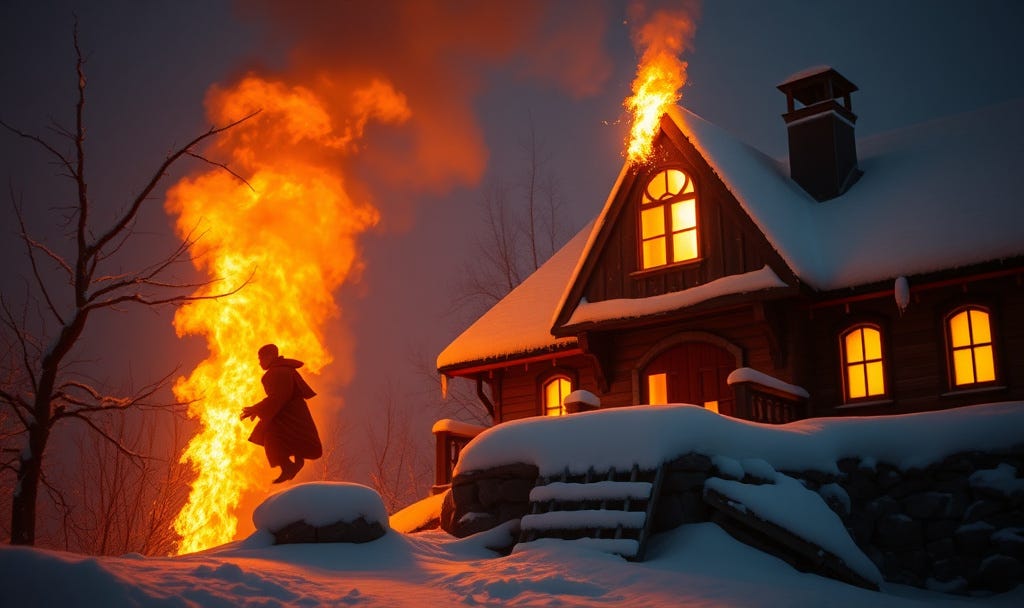
There’s a story told about Thomas Keating.
A monastery catches fire in the middle of the night. Smoke filling the halls. Heat moving through the walls like something alive.
Keating wakes up, realizes what’s happening, and does the only sensible thing.
He jumps out the window.
Lands in the snow. Cold, shocking, immediate. Breath gone, then returned like a second chance.
He’s alive.
And then he looks around.
Other monks are landing too. One by one. Black robes against white ground. A kind of silent snowfall of bodies.
The monastery burning behind them.
And no one says a word.
No one breaks the vow of silence.
Not to warn.
Not to shout.
Not even, apparently, to say, “Hey, the building is on fire.”
I’m sorry, but this story is wild.
A little holy. A little absurd.
When your home is on fire, shouldn’t you break the silence?
Then again…
Maybe the silence saved their lives.
Maybe it helped them hear what mattered.
Maybe some things are meant to burn.
peace,
Daniel
About the author: Daniel Gutierrez, Ph.D., LPC, CSAC, is a Contemplative Existential Psychotherapist, Mental Health Researcher, Professor & sometimes silent mime
Thank you.