

“Freedom is the capacity to pause…”
—Rollo May, Freedom and Destiny
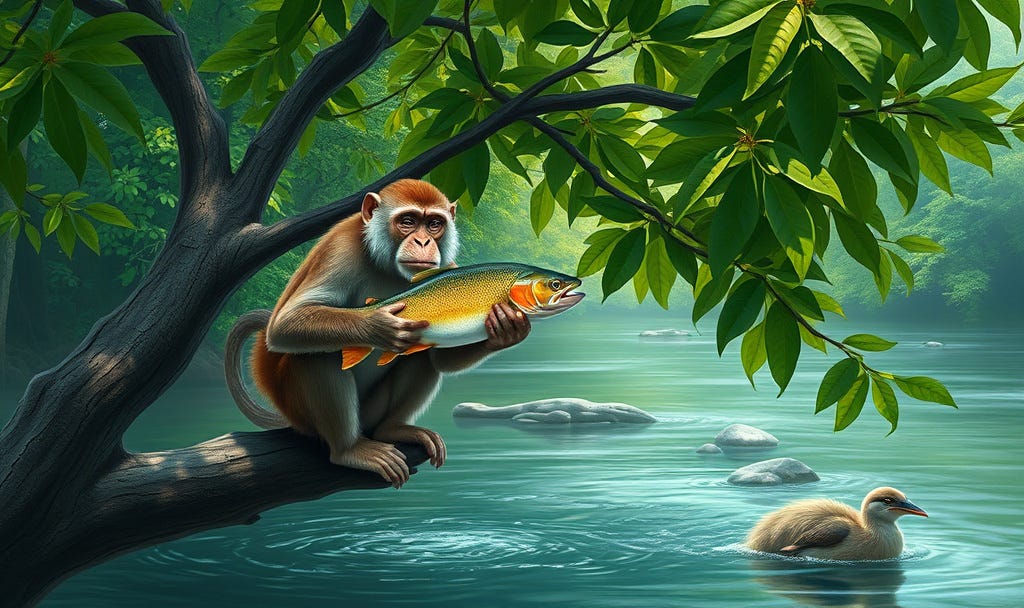
There is an old story about a monkey who sees a fish swimming in a river.
From the monkey’s point of view, the situation is obvious. The poor creature is underwater. Surely it must be drowning. So the monkey reaches down, pulls the fish from the river, and places it safely on a branch.
You can imagine the monkey’s satisfaction.
I have saved him.
Of course, the fish dies.
The monkey had mistaken its own habitat for the universal condition of life. What would drown the monkey was the very thing that allowed the fish to breathe. What looked like freedom from the river was not freedom at all. It was death.
I have come to love my therapist. Still, I sometimes wonder if what I pay him for each week is simply to remind me that I am already free.
Free within reality itself, right where I am. Free to choose. Free to pause. Free to stop letting my mind pull me out of the river where I belong in order to conform to some monkey’s idea of what “I should be” doing.
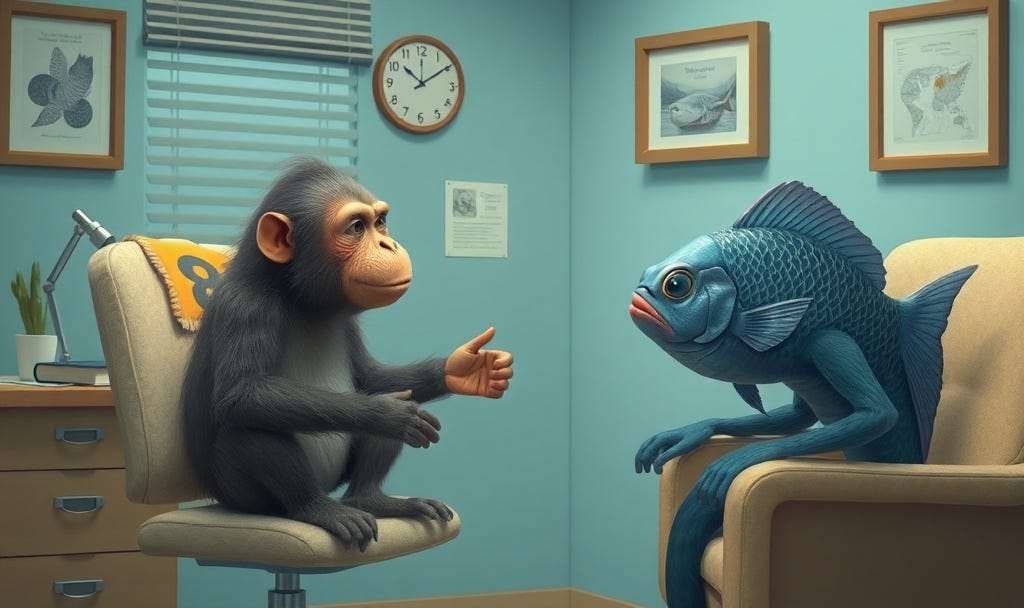
A session will often go like this: I bring him something that is vexing me. Some choice. Some relationship. Some imagined catastrophe that has me twisted in knots. I make my case with the confidence of a man who has mistaken worry for evidence.
He listens.
Then he clears his throat, somehow eloquently, and asks something painfully simple.
“What’s holding you back?”
And just like that, the cartoon light bulb flickers on above my head.
I realize I have more choices than I allowed myself to see.
This sounds simple, maybe even embarrassingly simple. But it is not. At least, not to me.
Because when I am inside the story, it does not feel like a story. It feels like reality. It feels like the obvious truth of things. It feels like the river is dangerous, the branch is safe, and any reasonable person would know the difference.
Stories are powerful that way. They do not merely entertain us. They organize reality. They tell us what matters, what is dangerous, what is possible, who we are, who belongs, what must be feared, and what can be hoped for. A story can build a civilization. A story can also help bring one down.
This is one of the great insights of Yuval Noah Harari’s Sapiens. Homo sapiens did not become the dominant human species simply because we were stronger, faster, or kinder than the others. We became powerful, Harari argues, because we learned to imagine together.
Other animals communicate. Other animals cooperate. Some even grieve, play, strategize, and form complex bonds. But Homo sapiens developed an astonishing capacity to organize life around shared stories: gods, tribes, nations, money, laws, rights, borders, corporations, universities, religions, revolutions, futures.
Many of these things are not “real” in the same way a river is real, or a fish is real, or a hand pulling a body from the water is real. You cannot put a nation under a microscope. You cannot find a corporation walking through the woods. You cannot hold justice in your hands like a stone.
And yet these stories move the world.
People cross oceans for them. They go to war for them. They marry inside them, pray inside them, work inside them, vote inside them, die inside them, and sometimes kill for them. Human beings can cooperate with strangers because we have learned to live inside shared meanings. We can trust people we have never met because they believe, or at least behave as if they believe, in some of the same stories we do.
This is not a small thing.
A dollar bill works because enough of us agree to live inside the story of money. A university works because enough of us agree to live inside the story of knowledge, credentialing, discipline, inquiry, expertise, and public good. A nation works because enough of us agree, however imperfectly and contentiously, to live inside a shared imagination of belonging. A marriage, a church, a courtroom, a hospital, a recovery meeting, a protest, a funeral — each depends on stories that teach us what we are doing and why it matters.
Story is not decoration.
Story is infrastructure.
It is one of the hidden architectures of human life.
This is what makes us magnificent and dangerous. We are the animal that can imagine a world that does not yet exist and then organize our lives around it. We can imagine freedom before freedom arrives. We can imagine justice before justice is written into law. We can imagine healing before the wound has closed. We can imagine a future and then ask one another to walk toward it.
But the same capacity can also trap us.
If a liberating story can help people rise, a destructive story can teach them to hate. If a healing story can help someone survive, a false story can convince them they are worthless. If a shared myth can build a community, it can also justify exclusion, domination, violence, or despair.
This is why the stories we live by matter so much.
They are not only ideas in our heads. They become habits in our bodies. They become institutions. They become reflexes. They become policies, rituals, diagnoses, family roles, religious identities, political loyalties, personal limitations, and private prisons.
The monkey had a story.
Water is danger.
Branches are safety.
Rescue means removal.
The fish had another reality entirely.
And this is where my therapist, Harari, and that poor unfortunate fish start to converge for me. So much of human suffering begins when a story becomes invisible to us. We forget we are living inside an interpretation. We forget that what feels obvious may only be familiar. We mistake the story for the world itself.
The old story says, You have no choice.
The old story says, You are not enough.
The old story says, No one will stay.
The old story says, You are only valuable when you are useful.
The old story says, If you stop moving, everything will fall apart.
The old story says, The river is the problem.
And then, sometimes, if grace or therapy or exhaustion or courage has done its work, someone asks:
“What’s holding you back?”
For one brief moment, the story becomes visible.
That moment matters.
Because freedom begins when the story becomes visible.
I think Psychologist Rollo May has good stuff to say about this:
May understood that freedom is not the fantasy of being untouched by the past. He rejected the idea of tabula rasa - that we are blank slates drifting through an open field of infinite possibilities. He acknowledged that we are born into bodies, families, histories, cultures, wounds, temperaments, losses, obligations, and limits.
We inherit stories before we know they are stories.
We absorb expectations before we know they are expectations.
We carry names, roles, loyalties, fears, hopes, and sorrows that began before we ever had language for them.
May called this the realm of destiny: the given material of a life.
But destiny is not the same as fatalism.
That distinction feels essential.
The river is destiny. The fish does not choose the need for water. It does not become free by pretending it can breathe on a branch. Its freedom is not freedom from the river, but freedom within the river.
We do not become free by escaping every condition that has shaped us. We become free when we can respond creatively within the real conditions of our lives. We are shaped, but not sealed. We are conditioned, but not condemned. We inherit, but we can also answer. We are free to choose how we respond (to paraphrase Viktor Frankl).
Somewhere between the story we were given and the life still asking to be lived, there is a pause.
And in that pause, the self begins to appear.
Maybe this is why therapy can feel so ordinary and so miraculous at the same time. Most sessions do not look dramatic from the outside. The ocean never parts. The angels don’t descend. And, only rarely is there a cinematic score rising in the background (usually coming from my Spotify playlist).
Someone sits in a chair and says the thing out loud.
Someone else listens.
A question is asked.
A silence opens.
A story loosens its grip.
“What’s holding you back?”
The question is almost annoyingly simple.
But sometimes that is all it takes.
The story is still there.
The fear is still there.
The wound may still be there.
But I am no longer identified with it.
That is not a small thing.
Many of our most painful stories began as acts of protection. This is why we should be careful not to despise them too quickly.
A child learns to be pleasing because anger was dangerous. A person learns to achieve because praise was the only reliable form of love. Someone learns not to need because needing once led to humiliation. Someone learns to stay busy because stillness brings grief too close.
These stories are not stupid. They are often intelligent adaptations to pain. They helped us survive a particular season. They kept us attached, protected, admired, safe, or at least less alone.
But what protects us in one season can imprison us in another.
A survival story can become a cage.
The same is true of culture. Whole societies live inside stories that begin to feel like common sense: worth equals usefulness, rest must be earned, freedom means having no obligations, suffering means failure, certainty is strength, visibility is significance, the self must always be optimized.
These stories enter our calendars, our bodies, our ambitions, our institutions. We begin to feel guilty for being tired, ashamed for needing help, anxious when we are not improving ourselves, suspicious of silence, and afraid of ordinary love.
This is why freedom cannot simply mean escape.
Escape from what? Into what? For whose sake? According to whose story?
The monkey thought it was freeing the fish. But the monkey did not understand the fish. It only understood its own fear of drowning.
We do this to ourselves all the time.
We try to free ourselves from the very things that allow us to breathe: the body, grief, responsibility, dependence, history, love, limitation, belonging.
But freedom is not the absence of all givenness.
Freedom is the creative response to what has been given.
That is the part I keep needing to remember.
I am not free because I have no river.
I am free when I can learn the waters that allow me to breathe.
Of course, some rivers really are dangerous. Some stories really are cages. Some families, systems, institutions, and inherited myths do not give life. They take it. Freedom sometimes does mean leaving. It sometimes means breaking silence, refusing a role, disappointing the monkey, climbing out of poisoned water, or letting an old world collapse so a truer one can begin.
But even then, freedom is not merely escape.
Freedom is discernment.
It is learning what gives life and what steals it. It is learning which waters are yours and which ones have been polluted by fear, shame, violence, or someone else’s imagination. It is learning the difference between a limit that protects life and a cage that slowly diminishes it.
Maybe that is what therapy does at its best. Maybe that is what prayer does. Maybe that is what contemplation does. Maybe that is what any true friendship does.
It helps us hear the story we have been living inside.
It asks, gently but persistently:
Is this true?
Is this still loving?
Is this still large enough for the life trying to be born in me?
Sometimes the answer is yes.
Sometimes the river really is where we breathe. Sometimes the commitment, the body, the grief, the community, the work, the ordinary practice of staying is not a cage but a calling.
And sometimes the answer is no.
Sometimes the story has expired. Sometimes what we called loyalty was fear. Sometimes what we called wisdom was resignation. Sometimes what we called peace was numbness. Sometimes what we called freedom was isolation.
The work is not to reject every story.
The work is to discern which stories still carry life.
We are shaped, but not sealed.
We are wounded, but not only wounded.
We are conditioned, but not condemned.
We have a past, but we are not merely its servant.
Maybe freedom is not the power to invent ourselves from nothing.
Maybe freedom is the courage to pause inside the story we were given and ask whether it is still true, still loving, and still large enough for the life trying to be born in us.
And if not, perhaps the most human thing we can do is begin again.
About the author: Daniel Gutierrez, Ph.D., LPC, CSAC, is a Contemplative Existential Psychotherapist, Mental Health Researcher, Professor & Free as a fish in a river
Thanks for the wisdom here! Free as a fish in a river...
Thank you for this. It is beautifully insightful.