

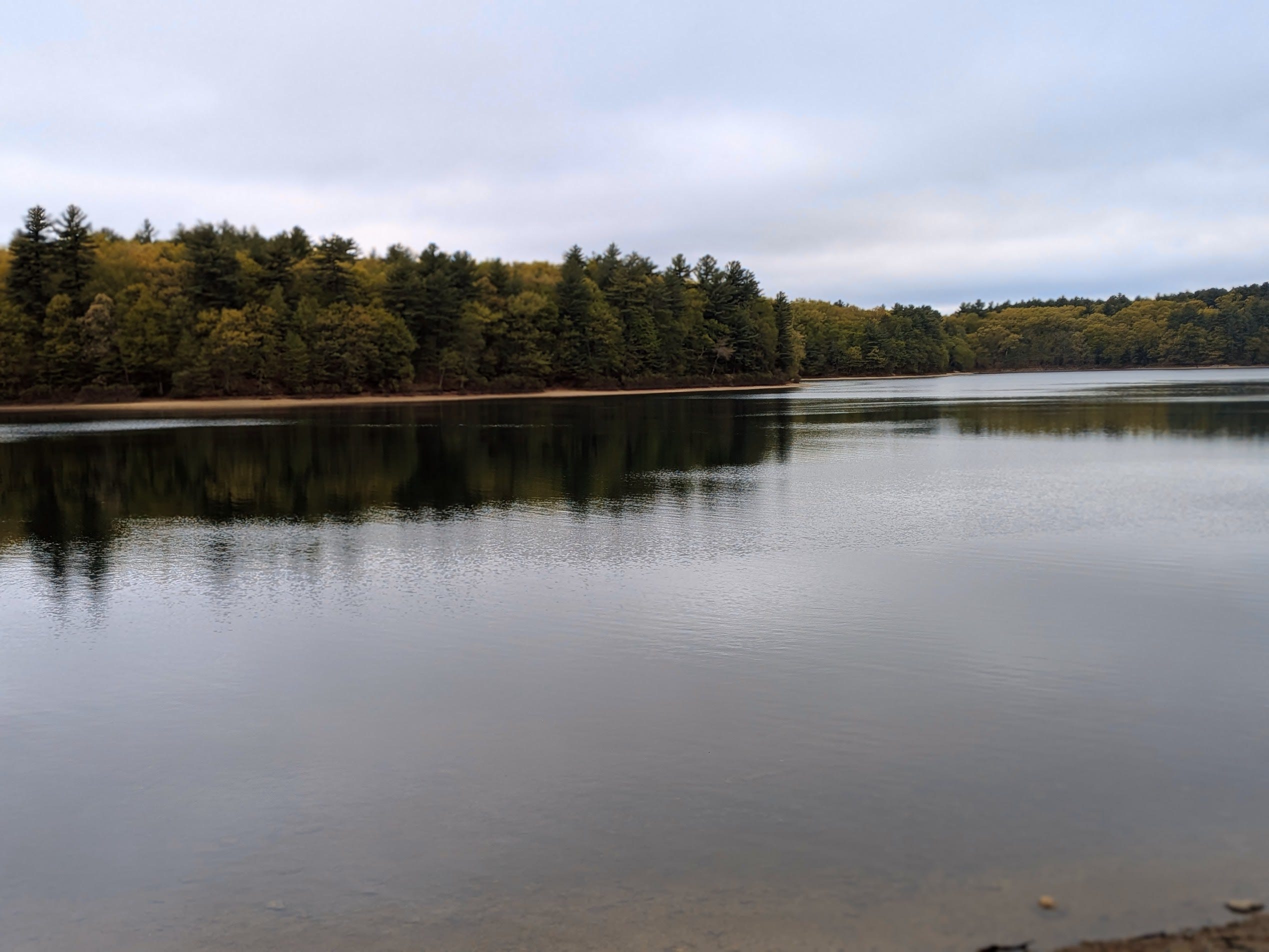
“I went to the woods because I wished to live deliberately… and not, when I came to die, discover that I had not lived.”
Henry David Thoreau, Walden
I was fourteen years old the first time I read Walden.
I think it was assigned reading for a class, though I cannot remember which one. What I do remember is the strange feeling that book gave me. For those unfamiliar, Walden is Henry David Thoreau’s reflection on living beside Walden Pond in the mid-1800s after he spent over two years in a small cabin he built himself.
The book is part philosophy, part spiritual reflection, part social critique, and part long-form argument that modern people are making themselves miserable.
Thoreau’s solution was simple:
Go to the woods.
Or at least stop living like your soul works for a corporation.
At fourteen, this hit me like a transcendentalist pied piper.
I was ready to grow a giant General Lee-meets-ZZ Top beard, disappear into the wilderness, and emerge two years later having discovered Ultimate Truth beside a squirrel.
To be clear, I did not literally want to live in the woods.
I enjoy indoor plumbing.
And I hate mosquitoes.
Still, something about Thoreau stuck with me.
Throughout his writing was an unobstructed vision of beauty and a quiet intuition underneath it all: modern life was becoming spiritually crowded.
Too much noise.
Too much striving.
Too many unnecessary things demanding attention.
Years later, after reading the Desert Fathers and Desert Mothers, I sensed that same intuition reflected in their words.

The desert monastics of early Christianity fled into the wilderness for many reasons, but one of them was profoundly psychological and spiritual: they believed society had become too loud to hear God clearly.
Empire had crowded out attention.
Status had crowded out presence.
Noise had crowded out the soul.
So they withdrew into silence because life was sacred enough to deserve deeper attention.
Recently my friend Rev. Tripp Hudgins wrote a beautiful reflection on monastic life at Richmond Hill. One line stayed with me. He described monastic communities as “borrowers,” inheritors of ancient practices meant to help human beings live together, pray together, and remember what matters.
Borrowers.
That language feels right to me.
Maybe Thoreau was borrowing too.
Borrowing from the same ancient instinct that keeps resurfacing whenever human life becomes fragmented and exhausting: simplify.
Not because reality itself is simple.
Dear God, reality is astonishingly complex.
Your circulatory system alone borders on practical magic. Roughly 60,000 miles of blood vessels quietly move oxygen through your body while electrical impulses race through your nervous system fast enough to produce thought, memory, grief, desire, consciousness, and the occasional inexplicable craving for gas station nachos at 11:30 at night.
Meanwhile the earth rotates through gravitational fields around a burning star while galaxies drift through an expanding universe vast enough to make your tax return feel slightly less emotionally significant.
Reality is gloriously intricate. It is enough just on its own.
The problem is not complexity.
The problem is artificial complexity.
The endless static layered on top of reality until we can no longer hear our own lives.
Artificial complexity is what happens when every moment becomes monetized, optimized, branded, measured, tracked, posted, analyzed, and turned into content. It is answering emails while checking text messages while listening to a podcast about mindfulness while half-reading an article about how screen time is destroying your attention span.
It is being unable to sit at a stoplight without reaching for your phone like a nicotine addict searching for existential reassurance.
It is treating exhaustion like an accomplishment.
And spirituality, unfortunately, is not immune to this.
Sometimes spirituality becomes just another form of artificial complexity. A performance. A curated aesthetic of enlightenment.
The ego loves to sneak into the monastery wearing linen pants and carrying a journal.
We collect spiritual practices the way medieval kings collected relics. Retreats. Crystals. Books we mostly underline but never absorb. We talk about healing journeys while remaining terrified of being still long enough to actually encounter ourselves.
Psychologists sometimes call this spiritual bypassing: using spiritual ideas to avoid unresolved pain, grief, responsibility, or vulnerability. Chögyam Trungpa famously called another version spiritual materialism, the tendency to turn spirituality itself into acquisition, achievement, or ego enhancement.
Which means even our attempts to escape artificial complexity can become artificially complex.
Ironically, therapy can become this too.
As a therapist myself, I say this lovingly and with full awareness that somewhere a wellness influencer is currently selling a seventy-four-dollar candle called “shadow work.”
My own therapist, a man I have grown to love deeply despite the fact that his challenges occasionally leave me wondering why I continue paying for this emotional assault, often reminds me of the Zen phrase:
“Chop wood. Carry water.”
Before enlightenment, chop wood and carry water.
After enlightenment, chop wood and carry water.
The point, as I understand it, is that life is always complicated. That living, especially living well, can be complex. But healing often involves returning to reality rather than escaping it.
So, the practice is often to just: Simply, come back to reality.
You do not need to waste time with all the added bells and whistles.
Life is complex enough.
You do not need any artificial sweeteners. Life is sweet enough on its own.
Just come back to the simplicity of a tree being a tree.
A relationship being a relationship.
A job being a job.
Love being love.
“Chop wood. Carry water.”
Presence instead of performance.
Authenticity instead of mastery.
Artificial complexity convinces us that salvation lies in accumulation: more knowledge, more optimization, more achievement, more self-improvement.
But healing may have less to do with accumulation than radical honesty.
Less to do with constructing an idealized self than becoming present to the self already here.
And maybe this is where contemplative traditions, psychotherapy, and even Thoreau unexpectedly meet.
Each at their own Walden Pond, a place where they can recover a direct experience of reality.
The monks called it recollection.
Zen calls it presence.
Psychotherapists might call it integration.
Whatever language we use, the intuition feels remarkably similar:
Fragmentation exhausts the human spirit.
Attention is finite.
And whatever fragments attention eventually fragments the soul.
Maybe that is why Thoreau still speaks to people.
Maybe that is why people still visit Walden Pond.
Not because we all secretly want to live in cabins and churn our own butter beside a pond.
Honestly, most of us would not survive forty-five minutes without Wi-Fi and antihistamines.
But because somewhere beneath the noise, beneath the striving, beneath the endless psychic clutter of modern life, many of us suspect the same thing the monks suspected long ago:
We have become too scattered to hear what is sacred anymore.
And perhaps simplification is not about escaping life.
Perhaps it is about returning to it.
peace,
Daniel
About the author: Daniel Gutierrez, Ph.D., LPC, CSAC, is a Contemplative Existential Psychotherapist, Mental Health Researcher, Professor & Artificially sweetened sometimes.
There's always been a part of me that's wanted a sort of Thoreau experience. A few years back I remember looking at magazines advertising plots of land for sale. I devoured old copies of Mother Earth News, and books on Tiny Houses. Part of me still pines for deserts, or cabin homes, or wide open places where it feels quiet enough to hear God whisper.
Yes!